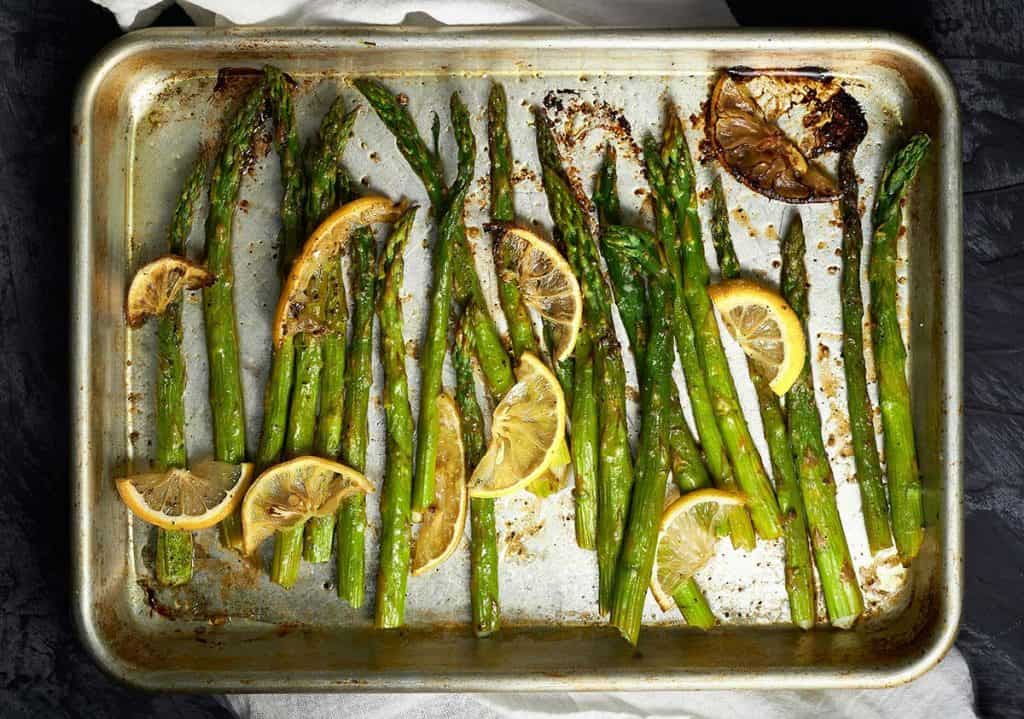
The asparagus comes in, and people start cooking it the same way every year.
Straight into a pan. Butter or oil. A few minutes and it’s done. That’s usually the first move, especially with the thinner stalks that show up early across the Pioneer Valley.
Roasting tends to wait.
Not for any real reason. Just timing. By the time you’re seeing more of it, from the southern end of the valley up through Sunderland and into Greenfield, you’re buying it more often, bringing home larger bunches, and the oven starts to make more sense than the stovetop.
It’s easier to handle that way.
The first thing is the asparagus itself, and it’s not always consistent. Early on, you’ll get thinner pieces, sometimes uneven, a little irregular. Later in the season the stalks thicken up and hold together more cleanly. It helps to separate them, even if you’re not thinking too hard about it. The thinner ones don’t need much time. The thicker ones will take it.
You can rinse it, or not. If it looks like it needs it, rinse it. Some people soak it for a few minutes in cold water, which does seem to help a little, especially if it’s been sitting out. Not long though. Five minutes is plenty. Longer than that and you’re just filling it with water.
Trim the ends after that. They’ll tell you where to cut if you bend them, but a knife works just as well.
The thicker stalks sometimes benefit from a quick pass with a peeler. Just the lower part. You don’t need to be precise about it.
Then it’s heat.
A hot oven works best. Somewhere around 400, maybe a little higher. You can go lower, but it softens before it browns, and that’s not usually what you’re after. Spread the asparagus out so it isn’t touching too much. That part matters more than most people expect. If it’s piled up, it steams, and once it starts steaming you’ve lost the edge you were trying to get.
A little oil, some salt, into the oven.
The thinner asparagus cooks quickly. Eight minutes, maybe ten. The thicker ones take longer. Twelve, fifteen, sometimes a bit more depending on how crowded the pan is and how hot the oven actually runs. You start to see some color, a bit of wrinkling along the stalk, the tips tightening and just beginning to crisp.
That’s usually the moment.
It doesn’t stay there very long.
If you’ve ever left it in “just another minute,” you know how fast it tips over. It softens, then it goes further than you meant it to. It’s not ruined, but it’s not what it was a minute earlier either.
There’s always the question of whether the oven is better than the pan.
It isn’t, really. It’s just different. A pan is faster. You stay with it, move it around, pull it when it’s ready. The oven gives you space. You can put it in and turn your attention to something else, which is usually the real reason people use it.
Either way works.
What matters more is not overcooking it. People tend to wait for asparagus to go completely soft, which is understandable, but not quite right. It should still push back a little when you bite into it. If it doesn’t, you’ve gone too far.
The other common mistake is crowding. After that, it’s usually too little heat, or trying to add too many things at once.
It doesn’t need much.
Once it comes out, you can leave it alone or add something small. Lemon works. Parmesan works. Pepper, a little more oil. That’s about as far as most people need to go, at least with the first few bunches of the season.
Later on you can start doing more with it.
Around here, a lot of what shows up at Millstone Market is coming from nearby fields, including Warner Farm. It hasn’t been traveling long distances or sitting in storage, and that changes how it cooks more than anything else you do to it.
You notice it without needing to think about it.
By the time you’ve gone through a few bunches, you stop measuring anything. The oven’s already on, you know roughly how long it takes, and you pull it when it looks right.
That’s usually enough.